Cursive Lowercase Letters a–z
Study all 26 cursive lowercase letters in one consistent handwriting model, learn entry and exit strokes, tackle the trickiest letters and print a lowercase a–z sheet.
Cursive lowercase letters a–z chart
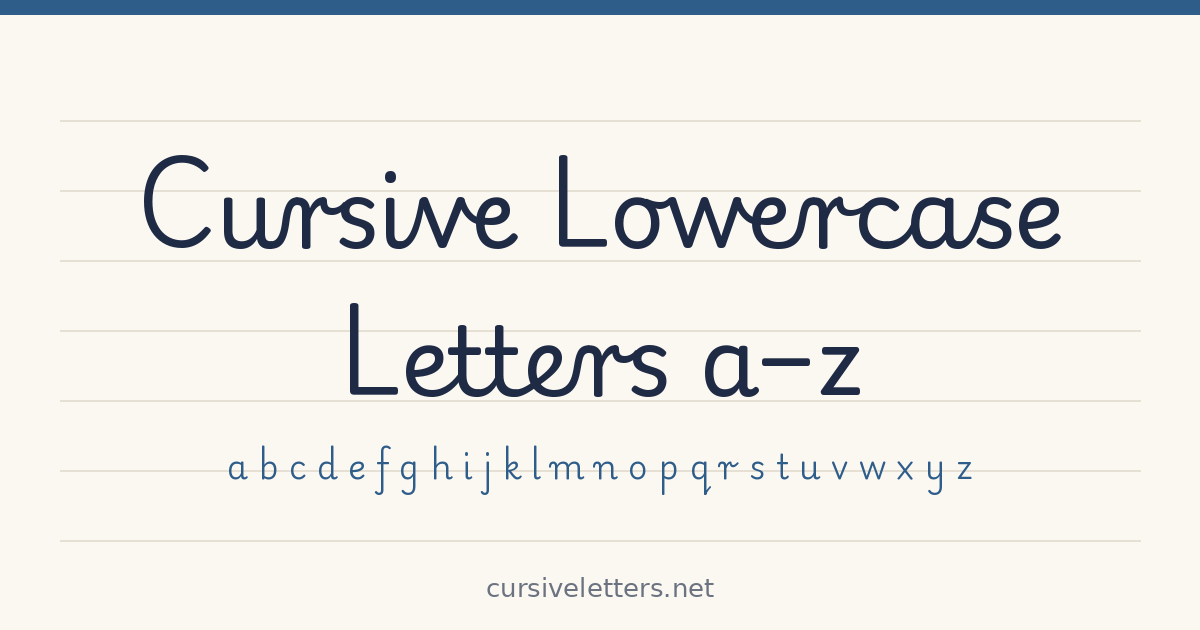
This lowercase-only chart shows every small letter in Playwrite US Modern next to its print form. Select any letter to open its guide with the lowercase and capital forms, practice words, joins and a printable sheet.
Looking for uppercase? Use the cursive capital letters A–Z chart, or see both cases together on the cursive alphabet hub.
How tall are cursive lowercase letters?
Lowercase letters sit in three height zones. Getting the zones right does more for readability than perfect shapes, because size is the first thing a reader notices.
| Height zone | Letters | What to watch |
|---|---|---|
| Small letters (baseline to midline) | a c e i m n o r s u v w x | Keep them all the same height; e should not grow into an l. |
| Tall letters (reach the top line) | b d f h k l t | Make loops and stems clearly taller than small letters; t is often a little shorter. |
| Descending letters (below the baseline) | g j p q y | Keep the tails the same depth and close any lower loops at the baseline. |
These zones follow print letter heights. In many cursive models, f and z also extend below the baseline, so compare each with its letter guide before you practice.
How do you write a cursive a lowercase?
Lowercase a is a good first letter because its oval shape repeats in c, d, g, o and q. Use the cursive A guide to compare the finished Playwrite form while you practice.
- Start with the entry stroke: move up from the baseline toward the midline.
- Form the oval: curve back and around to make a small, closed oval between baseline and midline.
- Close and come down: return to the top of the oval and pull a short stroke down to the baseline.
- Add the exit stroke: swing up and to the right, ready to join the next letter.
The most common problem is an oval left open at the top, which can make a look like u. Check that the top is closed before adding speed.
Entry strokes, exit strokes and joins
What makes cursive lowercase letters different from print is the connecting stroke. Most letters begin with a lead-in from the baseline and end with an exit that becomes the start of the next letter. The basic movements are covered in cursive strokes.
- Baseline exits: most letters, such as a, d, i and u, finish low and join upward into the next letter.
- Midline exits: in many models, b, o, v and w finish higher, so the following letter starts at the midline. These are often called bridge or high joins.
- Descender exits: letters such as g, j and y can loop back up from below the baseline to join.
Practice difficult pairs on their own before full words. Our cursive letter joins guide has examples such as br, os and we.
Group lowercase letters into families
Rather than learning 26 unrelated shapes, group letters that share a movement. Rounded oval letters, hump letters, looped tall letters and descending letters each repeat a pattern, so practicing one shape helps several letters at once. Groupings vary between handwriting programs, so read cursive letter families for a method-neutral approach.
What is the hardest cursive letter to write?
There is no single hardest letter for every learner, but some lowercase letters cause problems more often because of how they are built. These are worth extra comparison against the model.
The common cursive mistakes page lists more problems to check.
In what order should cursive letters be taught?
There is no universal order. Different handwriting programs use different sequences, but many share one idea: teach letters that begin with the same stroke together, and lowercase before capitals, since lowercase letters appear far more often in writing. One common pattern looks like this:
- Simple upstroke letters: i, t, u, w.
- Looped tall letters: e, l, h, k, f, b.
- Oval letters: a, d, g, o, c, q.
- Hump letters: n, m, v, x, y, z.
- Remaining letters: r, s, p, j, practiced with words.
Whatever order you choose, add short words as soon as a few letters are learned. Our how to write cursive guide shows the full path from strokes to words.
How to practice cursive lowercase letters
Short, regular sessions work better than long, occasional ones. A simple routine:
- Copy one row of a single letter, aiming for even size and slant.
- Write the letter between two others, such as ana or ele.
- Write two or three short words that contain it.
- Write it once from memory, then compare with the chart.
Build custom tracing rows with the cursive worksheet generator, then move on to cursive word practice.
Free printable cursive lowercase letters sheet
The print sheet below keeps all 26 lowercase letters together as a compact reference. Use your browser’s Print command at 100% / Actual Size.
- Cursive lowercase letters use entry and exit strokes so they can join.
- Keep small, tall and descending letters in their correct height zones.
- b, o, v and w often exit at the midline, which changes the next join.
- Letters such as b, f, k, r, s and z deserve extra comparison.
- Teach related letters together and add words early.
Cursive lowercase letter questions
How do you write a cursive a lowercase?
Start with an upstroke, curve around into a small closed oval, return to the top, pull a short stroke down to the baseline and finish with an exit stroke.
What is the hardest cursive letter to write?
It varies by learner, but lowercase b, f, k, r, s and z often need extra practice because of midline exits, tall loops or shapes that differ from print.
In what order should cursive letters be taught?
There is no single order. Many programs teach lowercase first and group letters by their starting stroke, such as upstroke, loop, oval and hump letters.
Should I learn lowercase or capital cursive letters first?
Most learners start with lowercase, because lowercase letters make up most of what we write. Add capitals once you can join small letters into words.
Do all cursive lowercase letters connect?
In most cursive models nearly all lowercase letters join, but the exit height changes. Follow the letter guide for the model you are using.
Practice a specific lowercase letter
Pick a letter from the a–z chart, then move from a single row to joins and short words.
Start with lowercase a →Cursive Lowercase Letters a–z
Lowercase practice • Playwrite US Modern
Print at 100% / Actual Size